“If you like your plan, you can keep it” and other half truths

If you like your plan and you like your doctor, you won’t have to do a thing. You keep your plan. You keep your doctor.

President Barack Obama, press conference, June 23, 2009

It’s one of those statements that will live on political infamy — like when George H.W. Bush said, “Read my lips. No new taxes” during his 1988 campaign and then later decided to raise taxes. And, in Obama’s case, he kept repeating it or at least a version of it as late as 2012.

So did former Health and Human Services secretary Kathleen Sebelius.

The bottom line is that under the Affordable Care Act, if you like your doctor and plan, you can keep them.

HHS Secretary Kathleen Sebelius, June 14, 2010

Obviously there are millions of people who were unable to keep their old plans, and some people have had to switch doctors. And conservative opponents of the Patient Protection and Affordable Care Act of 2010 (a.k.a. PPACA or Obamacare) have gleefully pounced.

Millions of people have lost their health insurance. Millions of people can’t see their own doctors.

Americans for Prosperity ad

The Administration is recognizing the grim reality that more Americans have lost health insurance than gained it under Obamacare.

Senator Marco Rubio (R-FL), press release, December 19, 2013

Cutting through the rhetoric — what really happened

All of the quotes above are misleading and confuse the issues at hand. (They are, after all, from politicians and political groups, so no one should be surprised at the sleight of hand.) They are all half truths. So I will try to parse them out and get to the whole truth.

The PPACA includes a provision for grandfathering plans that were already in place as of the date the law was signed (March 23, 2010).

SEC. 1251. PRESERVATION <<NOTE: 42 USC 18011.>> OF RIGHT TO MAINTAIN EXISTING COVERAGE.

(a) No Changes to Existing Coverage.–
(1) In general.–Nothing in this Act (or an amendment made by this Act) shall be construed to require that an individual terminate coverage under a group health plan or health insurance coverage in which such individual was enrolled on the date of enactment of this Act.

Patient Protection and Affordable Care Act of 2010 (emphasis added)

Based on that, it certainly sounds like what Obama and Sebelius said was completely true. So, with this very clear provision in place, how did so many people end up “losing health insurance?”

Insurers misleading the public

Private health insurance companies have been running afoul of state insurance commissioners for how they have communicated to their subscribers about changes related to the Affordable Care Act. Health insurer Humana was fined by the Kentucky Department of Insurance in 2013 for sending out misleading policy amendment letters to 6,543 subscribers. The penalty was $65,430 — $10 per subscriber who received the misleading letter.

While nothing in the law requires insurers to discontinue plans that were in place before the law was enacted, there’s also nothing in the law that prohibits them from discontinuing these plans. And private insurers were discontinuing plans long before Obamacare.

Even the conservative Heritage Foundation acknowledges that is what happened in this case.

But since the enactment of the Health Insurance Portability and Accountability Act of 1996 (HIPAA), insurers have been broadly prohibited from canceling or refusing to renew coverage. One of the few exceptions to that prohibition is if an insurer discontinues a particular plan or type of coverage. In such cases, the insurer must provide the affected individuals the option to enroll in any other applicable coverage that the insurer offers.

That is largely what happened with the 4.7 million plan cancellations that were reported at the end of 2013. The insurers were discontinuing their pre-Obamacare plans and offering policyholders replacement coverage that complied with Obamacare’s wide variety of new mandates and regulations.

The Heritage Foundation, “‘Junk’ Health Plans and Other Obamacare Insurance Myths,” February 11, 2014 (emphasis added)

This was no surprise

In June 2010, Obama administration officials from the Department of Health and Human Services predicted that exactly this would happen while writing the interim regulations for grandfathered plans.

Using these turnover estimates, a reasonable range for the percentage of individual policies that would terminate, and therefore relinquish their grandfather status, is 40 percent to 67 percent. These estimates assume that the policies that terminate are replaced by new individual policies, and that these new policies are not, by definition, grandfathered.

U.S. Department of Health and Human Services. “45 CFR Part 147: Interim Final Rules for Group Health Plans and Health Insurance Coverage Relating to Status as a Grandfathered Health Plan Under the Patient Protection and Affordable Care Act.” Federal Register, Vol. 75 No. 116, June 17, 2010.

So, Obama and Sebelius should have known better than to over-promise, especially in a situation where the thing that they promised would not happen would happen in such a clear and obvious way. Experts were even predicting this scenario long before the interim rules were written.

In October 2013, the White House was forced to clarify — saying what they should have said all along.

Nothing in the Affordable Care Act forces people out of their health plans: The law allows plans that covered people at the time the law was enacted to continue to offer that same coverage to the same enrollees – nothing has changed and that coverage can continue into 2014.

White House spokesperson Jessica Santillo, cited by USA Today, October 29, 2013

Yet for the people whose plans were canceled, Santillo’s more accurate explanation is a distinction without a difference.

Americans losing their doctors

A contract dispute close to home

Here in the Greater Indianapolis area where I live, we are home to Anthem Blue Cross and Blue Shield, one of the nation’s largest health plans. (I was employed there from 2008 to 2012.) But we also have some major hospital systems. The two largest are Indiana University Health and St. Vincent Health.

When Anthem began offering its health plans for Indiana in the federal exchange on HealthCare.gov, the company knew it was going to be competing not only with the only other exchange player (a non-profit called MDWise that is partly owned by Indiana University Health) but also with the individual mandate penalty for not buying insurance at all. So, in order to keep premiums on the exchange plans to a minimum, it offered low reimbursement rates to physicians and hospital systems participating in the exchange plans. Although the third- and fourth-largest hospital systems in the area (Community Health Network and Franciscan St. Francis Health Network) accepted the lower reimbursement rates, Indiana University Health and St. Vincent Health balked at the low reimbursement rates, leaving them out of network for anyone choosing an Anthem plan on the exchange. The MDWise plans on the exchange were priced comparably but included Indiana University Health and St. Vincent Health.

Perhaps more disconcerting to many Americans than having their plans discontinued was not always being able to keep their in-network physicians. But can this really be blamed on Obamacare?

Not in the slightest. There is nothing in the law that explicitly addressed this one way or another. The PPACA did not require people to change physicians, but it also did not explicitly require physicians to participate in any particular health plan. And contract disputes between physicians, hospitals, and health plans have been going on forever.

By 2000, many providers were pushing plans for large payment rate increases and more favorable contract terms, such as reimbursement based on a percentage of charges, to recover ground previously lost to health plans. Providers also experimented with more aggressive bargaining tactics, such as contract terminations or threatened terminations, to seek new contracts. Negotiations in a number of cases degenerated into bitter public disputes. Providers’ negotiating success emboldened other providers to push back and contract showdowns became commonplace across the country during 2000-01.

White, et al. “Getting Along or Going Along? Health Plan-Provider Contract Showdowns Subside.” Center for Studying Health System Change, Issue Brief No. 74, January 2004 (emphasis added).

The other side of the coin

Up until this point, I’ve been very critical of the Obama administration’s messaging for being imprecise or perhaps even deliberately misleading. But the opposition was also misleading.

When it came to keeping a current plan or a current doctor, Obama promised something that the law could not deliver. But it would also be misleading to blame the PPACA for a problem that was going on before it was passed and would have continued to happen whether it was passed or not.

When Sen. Rubio said “more Americans have lost health insurance than gained it under Obamacare,” he was making a doubly misleading statement.

First of all, the timing of his statement (December 19, 2013) was a premature assessment of the enrollment period that was still going until March 31, 2014. So it would not be surprising by that point in time that few people had enrolled…especially given the early technical problems with HealthCare.gov. By the time the 2014 enrollment deadline arrived, 7.1 million people had enrolled in private health plans on the exchanges — and, the last time I checked, that’s more than 4.7 million. And that doesn’t include the people who became newly eligible for Medicaid in the states that opted to expand it.

Secondly, those who had their plans cancelled did not lose their health insurance in the sense that they became uninsured. Their existing plans were discontinued, and they were left with many options to choose a new plan in order to remain insured. If a shoe manufacturer stops making your favorite brand of shoes, does that mean that you’ve become shoeless? No, you can just buy a different brand of shoes. That’s how free markets work. In fact, it’s a fairly safe bet that many of the 4.7 million who had their plans discontinued became part of the 7.1 million new enrollees in exchange plans.

If the PPACA had been written in a more explicit way that forced insurers to maintain plans that were in place before March 23, 2010 or forced physicians to participate in plans in which they did not find the contract terms acceptable, then the Republicans could have rightly accused Congress of overreaching and micromanaging these contractual relationships. So there was no realistic solution available to this problem. A single-payer system might have allowed nearly everyone to keep their current doctors (who’s going to go out of network when there’s only one payer?), but it also would have terminated EVERYONE’S health insurance plans. But any policy that addresses the cost drivers in the health care system and reforms the insurance market is bound to be at least a little disruptive. And that’s not a bad thing because some disruption was needed. The Obama administration’s mistake was to over-promise.

What have we learned?

Health policy is complicated, and all politicians have to speak in sound bites to explain themselves to the public by way of the news media. Also, what’s not written into a law may just be as important as what is written.

Politicians of all stripes will always be motivated to spin what a particular bill or law actually does. Those who support it will over-promise its benefits, and those who oppose it will exaggerate its flaws. That goes for any kind of legislation, not just the PPACA.

“Bleeding Belgium” is an ironic historical allusion for public health

Support among the American public for quarantine appears at this point to be overwhelming. You can know this if you walk down the street and ask people, or if you look at a CBS poll that found 80% of respondents think citizens returning from West Africa should be quarantined until it’s clear they do not have the disease.

But America’s ‘professionals’ in the scientific and medical communities, and certainly those in the White House, seem deeply uninterested in the views of common people. When pressed on the issue they, especially the president, offer only gobbledygook and slogans. We can’t be safe here until they’re safe over there! They sound like propagandists for Bleeding Belgium in World War I.

Peggy Noonan, “From Ellis Island to Ebola,” 10/31/2014

Leave it to right-leaning columnist Peggy Noonan of The Wall Street Journal to write something so transparently xenophobic that it defies all logic.

That “gobbledygook” Noonan is talking about is just the medical science she can’t understand. And she is not alone in her ignorance…which is no wonder why the scientific and medical “professionals” she is referring to “seem deeply uninterested in the views of common people.”

This from the same “common people” who wanted to quarantine AIDS patients in 1985 despite an understanding among public health professionals from years before how AIDS was and was not transmitted.

This propaganda piece appeared on page 14 of the New York Tribune on November 5, 1917. It made the emotional case that the United States needed to go to war to protect Belgium from Germany as a matter of U.S. national security.

This propaganda piece appeared on page 14 of the New York Tribune on November 5, 1917. It made the emotional case that the United States needed to go to war to protect Belgium from Germany as a matter of U.S. national security.

Considering that “common people” like Peggy Noonan describe medical and public health terminology as “gobbledygook,” thank goodness the professionals are disinterested in their views!

The end of the excerpt from Noonan compares the Democrats in the White House and the medical scientists to the U.S. Committee on Public Information propagandists from World War I who made the case that we needed to go to war in Germany to protect “Bleeding Belgium,” specifically making the argument that failing to protect Belgium made the United States less safe.

But Noonan’s failure to understand far more recent history makes her argument more comical ironic than absurd. Consider this November 16, 2002 quote from President George W. Bush as he made the case to go to war in Iraq.

We are committed to defending the nation. Yet wars are not won on the defensive. The best way to keep America safe from terrorism is to go after terrorists where they plan and hide.

In her column, Noonan told the story of Thomas Duncan, the Liberian national who died from Ebola after coming to the United States (and infecting at least two nurses who cared for him). He had originally tested negative before he left Africa but ultimately incubated enough of the virus to kill him.

As you might imagine, Duncan’s family has a few questions about the care he received.

To Noonan, this was a great reason to keep nurse Kaci Hickox — who had tested negative for Ebola and showed no symptoms — under mandatory quarantine after her return from Sierra Leone, where she temporarily worked with Doctors without Borders. (Hickox is also an employee of the U.S. Centers for Disease Control and Prevention, which certainly complicates matters a bit since she knows a thing or two about public health and epidemiology.)

Never mind that the only two people who became infected with Ebola because of Duncan were the nurses who cared for him. (After all, who else was coming into contact with his bodily fluids?)

By the way, Thomas Duncan entered the United States on a flight from — where else? — Belgium.

How the EPA might save us from Ebola

Now that the Ebola virus has reached the United States, there is understandably a lot of panic about it. The news media certainly isn’t helping to put our minds at ease.

Ebola certainly is a scary disease, but even in Africa, it’s way down the list of causes of death.

ebola

Graphic courtesy of World Health Organization.

That’s not to say that Ebola is not a terrible and deadly disease — it is — but once we are reminded that it only spreads through direct contact with bodily fluids (including human waste), then we may be more able to be more rational about it.

One major advantage that we have in the United States that people in West African nations lack is modern sanitation. In its list of Ten Great Public Health Achievements in the 20th Century, the Centers for Disease Control and Prevention listed infectious disease control as a top achievement and improvements in sanitation and hygiene as crucial strategies.

Disease control resulted from improvements in sanitation and hygiene, the discovery of antibiotics, and the implementation of universal childhood vaccination programs….

The 19th century shift in population from country to city that accompanied industrialization and immigration led to overcrowding in poor housing served by inadequate or nonexistent public water supplies and waste-disposal systems. These conditions resulted in repeated outbreaks of cholera, dysentery, TB, typhoid fever, influenza, yellow fever, and malaria.

By 1900, however, the incidence of many of these diseases had begun to decline because of public health improvements, implementation of which continued into the 20th century. Local, state, and federal efforts to improve sanitation and hygiene reinforced the concept of collective “public health” action (e.g., to prevent infection by providing clean drinking water). By 1900, 40 of the 45 states had established health departments. The first county health departments were established in 1908. From the 1930s through the 1950s, state and local health departments made substantial progress in disease prevention activities, including sewage disposal, water treatment, food safety, organized solid waste disposal, and public education about hygienic practices (e.g., foodhandling and handwashing). Chlorination and other treatments of drinking water began in the early 1900s and became widespread public health practices, further decreasing the incidence of waterborne diseases. The incidence of TB also declined as improvements in housing reduced crowding and TB-control programs were initiated. In 1900, 194 of every 100,000 U.S. residents died from TB; most were residents of urban areas. In 1940 (before the introduction of antibiotic therapy), TB remained a leading cause of death, but the crude death rate had decreased to 46 per 100,000 persons.

U.S. Centers for Disease Control and Prevention

So that’s a reassuring feather in our cap when fighting Ebola here at home. But we can’t afford to get complacent about it.

Here in my home town of Indianapolis, we have a dirty little problem that nobody wanted to talk about for years. Storm drains that collect rainwater and dump it into waterways are commingled with sewer drains (this is known as a combined sewer system). So, whenever there’s a good rain, well you can probably guess the results.

Each year, the city of Indianapolis dumps between six and seven billion — that’s billion with a B! — gallons of raw, untreated waste into Eagle Creek, Fall Creek, Pleasant Run, Pogues Run and the White River.

Bob Segall, WTHR-TV Indianapolis

That’s a lot of raw sewage overflowing into our waterways where people boat, fish and occasionally swim. Indianapolis’s sewer system is more than 100 years old and simply doesn’t have enough capacity. Scary stuff, especially in light of the Ebola outbreak.

The good news is that help for my hometown is on the way. Because these conditions were a violation of the Clean Water Act, the U.S. Environmental Protection Agency sued the city, which led to a settlement and a Consent Decree for the city to fix the sewage system. Essentially, the city is only doing it because the feds are making them do it. Politicians don’t want to be responsible for massive increases in utility rates.

The city, along with Citizens Energy Group, the public utility that operates the water, sewer and natural gas systems in Indianapolis, is currently building a massive tunnel system to add capacity and minimize (notice I didn’t say eliminate) the overflows. The bad news is that it won’t be done until May 2016.

Indianapolis is far from alone in its challenges with an antiquated sewer system. According to the EPA, there are 213 large systems (each serving 50,000 or more people) nationwide with combined sewer overflows and 1,103 additional large systems with sanitary sewer overflows. The goal is to address all of them by the end of FY2016 — but it will take years beyond that for all of the necessary projects to be completed.

fy 2013 cumulative progress on addressing combined sewer systems

Graphic courtesy of the U.S. Environmental Protection Agency.

2013 nei cumulative progress on addressing sanitary sewer systems

Graphic courtesy of the U.S. Environmental Protection Agency.

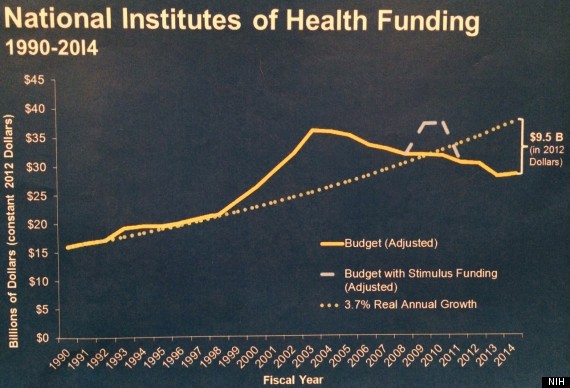
That’s why I find it totally incredulous that many voices within the GOP have proposed that we abolish the EPA altogether while simultaneously accusing the Obama administration of not being serious about protecting Americans from Ebola. Indeed, budget cuts have also hamstrung the CDC and the National Institutes of Health in their efforts to contain the disease and even develop a vaccine.

“NIH has been working on Ebola vaccines since 2001. It’s not like we suddenly woke up and thought, ‘Oh my gosh, we should have something ready here.’ Frankly, if we had not gone through our 10-year slide in research support, we probably would have had a vaccine in time for this that would’ve gone through clinical trials and would have been ready.”

Dr. Francis Collins, Director, National Institutes of Health

NIH funding

Graphic courtesy of National Institutes of Health.

Protect yourself from an epidemic far deadlier than Ebola

Americans are very concerned about the Ebola outbreak in Africa that has now made its way across our borders, and rightly so. Ebola is often deadly, and there is no known vaccine or cure (even though some people do survive it).

But there’s a far deadlier foe out there, and we can protect ourselves against it: Influenza.

Ebola has claimed fewer than 4,000 lives globally to date, none in the United States. Flu claims between 250,000 and 500,000 lives every year, including over 20,000 in the United States—far more American lives than Ebola will ever claim.

Ebola is no joke: The Centers for Disease Control project 1.4 million cases of the disease worldwide by January in a worst-case scenario. But by comparison, the 1918 pandemic killed an estimated 50 to 100 million worldwide. The United States simply cannot afford to be complacent about flu preparedness.

Kendall Hoyt, Politico.com

Ebola and influenza may both be devils, but influenza is the devil we know. Of course, most people who get the flu recover from it quickly — it’s unpleasant, but most people don’t think of it as a life-or-death issue. But, all too often, it is.

So, even though the Centers for Disease Control and Prevention (CDC) recommends that everyone over the age of six months get vaccinated, 55 percent of Americans did not get vaccinated during last year’s flu season…and last year was an improvement over previous years.

Skepticism of the flu vaccine still runs high, so it’s important that people understand the facts.

  • The flu vaccine cannot and will not cause you to get the flu. Period. Because of the way that the vaccine is made, it is impossible for the vaccine to give you the flu.
  • Just because you got the flu that one time after getting vaccinated does not mean the vaccine caused you to get the flu. Now, does that mean that you are guaranteed not to get the flu after you get vaccinated? No. According to the CDC, the efficacy is about 60% (whereas not getting vaccinated has an efficacy rate of 0%), and even when it does work, it usually takes about two weeks for your body
  • You are a good candidate for it. Yes, you. Although pregnant women, the elderly and immunocompromised people are at the highest risk of serious complications from influenza, you can do your part to help them even if you are healthy. It’s quite common to be contagious even while you are not experiencing flu-like symptoms. So getting vaccinated is not only for your health, it’s for everyone’s health.
  • It’s safe. Like any drug, there can be side effects from the flu vaccine…so there are a few instances when the flu vaccine is not a good idea. But, for the vast majority of people ages six months and up, the flu vaccine has been proven safe and effective (albeit not 100% effective) for many decades.

The bottom line is if you’re worried about Ebola, but you haven’t gotten a flu shot, your health priorities are severely out of whack.

I already got my flu shot this season. How about you?

The collision of medical privacy laws and celebrity

As a 2002 graduate of Butler University, I still follow Butler’s men’s basketball team closely just like many Butler alumni. I usually catch a game or two every season at Hinkle Fieldhouse. Of course, this sequence from the 2010 NCAA National Championship Game will be etched painfully into our memories forever.

In 2013 after Coach Brad Stevens left Butler to coach the Boston Celtics, one of my contemporaries on campus, Brandon Miller (who also played basketball for Butler from 1999 until 2003 when he graduated) was named head coach.

The 2013-14 season was a rough one for my Bulldogs for a number of reasons, but the 2014-15 season brought new hope to the team. With one season under Miller and one season in the Big East under the team’s belt as well as the return of Roosevelt Jones from injury…things were looking up. That is, until the university announced last week that Coach Miller was taking a medical leave of absence.

The university did not and legally could not disclose the reason for his absence, and Coach Miller isn’t talking either.

“Brandon Miller has requested a leave of absence for medical reasons, which the University has granted. We are not in a position to further elaborate and we ask that everyone respect Brandon’s privacy.”

Barry Collier, Athletic Director, Butler University

It’s natural to be curious about things like this, and when the person is a public figure like Coach Miller, the level of curiosity is ramped up a notch. But just because the public is curious doesn’t mean we have a right to know. So it really surprised me when I read this in The Indianapolis Star:

I want to emphasize this is just my opinion: Unless there is a legal reason not to do so, I think Brandon should be upfront about what he is dealing with, especially if he wants to return as coach.

Michael Pointer, reporter

Well, Michael, there are absolutely legal reasons not to do so. The Health Insurance Portability and Accountability Act of 1996 (HIPAA) protects Coach Miller’s privacy, and the Family and Medical Leave Act of 1993 (FMLA) protects his job. Just because we have different laws for public figures about defamation, libel and slander doesn’t mean that our laws related to health care are different for them as well.

I would think Michael Pointer would know this better than most people. A few months ago, I was attending an open mic night at a local comedy club. Pointer took the stage and explained to the audience that he was in the midst of a medical leave from the Star — and that doing stand-up comedy was part of his (mental health) therapy. As a member of the audience, I certainly have no obligation to protect his privacy…if he really cared, he wouldn’t have gotten behind a microphone and told a room full of people. Still, since he was on medical leave, he would have had to go through a lot of paperwork about HIPAA and FMLA himself.

The other thing for Pointer to remember is that just because Coach Miller didn’t explain his situation to the general public doesn’t mean that he didn’t explain it privately to the university. Maybe he did, maybe he didn’t.

The clinical importance of privacy

I’m not saying that this is what is happening with Coach Miller, because I honestly don’t know what his health status is. But I do think mental health is the best example of why it’s important that we keep health information private for everyone, including public figures.

According to a 2001 report by the World Health Organization, one in four people worldwide has a mental or neurological disorder. And one of the biggest obstacles to treatment is the social stigma associated with these disorders. So, in order to encourage people to get treatment, guaranteeing confidentiality is paramount.

Mental health policies and programmes should promote the following rights: equality and non-discrimination; the right to privacy; individual autonomy; physical integrity; the right to information and participation; and freedom of religion, assembly and movement.

World Health Organization. Mental Health: New Understanding, New Hope, 2001 [emphasis added].

I have also worked as a journalist who always wanted to know the scoop, but I hope Pointer and the public will show Coach Miller the same respect that we showed to him during his very public medical leave of absence.

Link

It’s still not a pretty picture in my home state of Indiana when it comes to preventable medical errors…like severe bed sores, wrong-site surgeries, foreign objects left inside of patients and falls. From The Indianapolis Star:

For the past eight years in an effort to curb the number of preventable mistakes that happen in Indiana, hospitals, ambulatory surgery centers, abortion clinics and birthing centers have been required to report 28 serious adverse events to the Indiana State Department of Health.

In 2013, 111 medical errors occurred at 293 facilities, according to a report recently released by state health officials. That’s more medical errors than have occurred in any year since the state started requiring facilities to report these events.

Indeed, preventable medical errors are the #3 cause of death in America, responsible for 1 out of 6 deaths. So this problem is literally killing us in very large numbers, and we don’t seem to be making much progress.

It doesn’t have to be this way. In a six-country survey, U.S. patients reported the highest rate of medical errors…a dubious honor indeed. (In case you’re wondering, the other five countries in the survey were the United Kingdom, Australia, Germany, New Zealand and Canada.)

I know that physicians and hospitals recognize this problem and are making good-faith efforts to improve this and trying all kinds of strategies to improve it. But why aren’t we making any real headway? Why is the care in the United States so uniquely inconsistent despite costing so much more?

If you’ve read enough of this blog, you probably know the reasons already.

What do you think? I’m interested to read your comments.

Obamacare under assault from disingenuous people looking for loopholes and political gain

I cannot think of a statute in our nation’s history that has ever been under such constant assault and sabotage after being passed than the Patient Protection and Affordable Care Act of 2010. In attempting to give states more control over their own destinies, Congress might have accidentally created enormous loopholes that undermine the law’s effectiveness. Perhaps they were overestimating conservatives’ sense of decency. In a truly stunning and baffling court decision, a 3-member panel of the D.C. Circuit Court of Appeals ruled 2-1 that subsidies for health insurance could only be granted through exchanges set up by states since that was the letter of the law. And, since most states refused to set up their own exchanges (usually the states run by Republican legislatures and governors), residents of those states had to use the federal exchange. Even the judges themselves knew they were helping people to get off on a technicality.

We reach this conclusion, frankly, with reluctance. District of Columbia Appeals Court judge Thomas Griffith

Fortunately, the 4th Circuit Court of Appeals in Richmond correctly interpreted Congress’s intent (perhaps they were paying attention during the debate over the bill) and ruled differently.

What they may not do is rely on our help to deny to millions of Americans desperately-needed health insurance through a tortured, nonsensical construction of a federal statute whose manifest purpose, as revealed by the wholeness and coherence of its text and structure, could not be more clear. 4th Circuit Senior Circuit Judge Andre Davis

So this seems like an issue destined for the Supreme Court if the 11-member appeals panel in the D.C. Circuit doesn’t overturn it themselves. I wouldn’t overreact to it yet.

What the Burwell v. Hobby Lobby decision really means for women’s health care

Whenever a landmark Supreme Court decision comes out, I try to find the decision itself and read it because I want to understand not only what the justices decided but how they decided it and exactly what it means. If you can get past the legalese, it’s often fascinating reading material no matter how you feel about the decision.

On June 30, 2014, the U.S. Supreme Court issued a decision in the case of Burwell, Secretary of Health and Human Services et al. v. Hobby Lobby Stores, Inc.. The court ruled 5-4 in favor of Hobby Lobby. I’d encourage you to read the decision of the court’s majority, written by Justice Samuel Alito and the concurrence from Justice Anthony Kennedy as well as the minority dissent written by Justice Ruth Bader Ginsburg. Please make up your own mind — don’t take my word for what any of it means.

Background: How we got here

In case you’ve been living under a rock for the past week, I’ll provide a bit of basic background on the case, which can also be found in the court opinion. I apologize if this falls into the category of TL:DR (too long, didn’t read), but the details are important.

A refresher from high school civics class

In case your memory from high school civics class is a little foggy, I’ll review an important concept. The U.S. Constitution is a framework that allows for four different types of laws, and judges might have to take all of them into account when reviewing a case. Deciding the rule of law correctly is a very difficult thing for any judge to do, and this is where good lawyers earn their high hourly rates.

  1. Statutory law. Statutes are the types of laws we normally think of that are passed by both houses of Congress and signed by the president. The framework for this is described in Article I.
  2. Administrative law. Under Article II, the executive branch is given the authority to carry out laws passed by Congress, and that often means writing administrative law. We often describe administrative laws as regulations. Whenever a president issues an executive order, he (or perhaps she in the future) is acting under the authority granted by Article II.
  3. Treaties. Article II also allows the president to make treaties with other nations…with the Senate’s consent. This isn’t really relevant to this case, but it is another type of law.
  4. Case law. Article III created the judicial branch, and when the judicial branch — especially the Supreme Court — makes a ruling, that ruling becomes part of the body of case law that can be cited as precedent in future cases. There is a principle in case law that you might have heard about before called stare decisis, which is Latin for “to stand by things decided.” To illustrate the importance of case law and stare decisis, Planned Parenthood of Southeastern Pennsylvania v. Casey was decided based on the previous precedent of Roe v. Wade in spite of statutes written by the Pennsylvania legislature.

In 1990, the Supreme Court ruled in another landmark case called Employment Division, Department of Human Resources of Oregon v. Smith. In this case, a man named Alfred Smith was fired from his job for ingesting peyote, which was both a religious sacrament in the Native American Church where he had membership — and an illegal drug in the state of Oregon. After being fired, Smith sought unemployment insurance benefits but was denied because Oregon law disqualified applicants who had lost their jobs due to “misconduct.” The court found in favor of the state government in Oregon (thus against Smith). An excerpt from that decision:

Although a State would be “prohibiting the free exercise [of religion]” in violation of the Clause if it sought to ban the performance of (or abstention from) physical acts solely because of their religious motivation, the [Free Exercise Clause of the First Amendment to the U.S. Constitution] does not relieve an individual of the obligation to comply with a law that incidentally forbids (or requires) the performance of an act that his religious belief requires (or forbids) if the law is not specifically directed to religious practice and is otherwise constitutional as applied to those who engage in the specified act for nonreligious reasons. Opinion of the Court in Employment Division, Department of Human Resources of Oregon v. Smith

This case prompted Congress to react, passing a statute called the Religious Freedom Restoration Act (RFRA) of 1993. It was signed into law by President Bill Clinton. This is the key excerpt from the statute:

SEC. 3. FREE EXERCISE OF RELIGION PROTECTED.
(a) IN GENERAL.—Government shall not substantially burden a person’s exercise of religion even if the burden results from a rule of general applicability, except as provided in subsection (b).
(b) EXCEPTION.—Government may substantially burden a person’s exercise of religion only if it demonstrates that application of the burden to the person (1) is in furtherance of a compelling governmental interest; and (2) is the least restrictive means of furthering that compelling governmental interest.

In plain English, RFRA was written for the express purpose of overturning the precedent set by Employment Division, Department of Human Resources of Oregon v. Smith, even going so far as to mention the case in the background of the statute. Remember this little nugget…we’ll come back to it.

Fast forward to 2012. After Congress passed the Patient Protection and Affordable Care Act of 2010 (aka Obamacare), the work of the executive branch — specifically the Secretary of Health and Human Services — to write regulations to implement the statute began. One of those regulations was called the Women’s Health and Preventive Services Guidelines, which took effect on August 1, 2012.

Essentially, these guidelines required all health insurance plans (except for those that were grandfathered in before the statute was signed by President Obama on March 23, 2010) to cover 20 FDA-approved contraceptives without any copays, deductibles or coinsurance. Under the Patient Protection and Affordable Care Act, organizations with 100 or more full-time employees are required to provide health insurance to them or pay a penalty of $2,000 per employee. So the financial stakes can be high.

After creating a firestorm with these guidelines, the Department of Health and Human Services walked back and exempted “religious employers” from being bound by the Women’s Health and Preventive Services Guidelines. The guidelines were very specific about what constituted a “religious employer,” (essentially a church or house of worship), and a for-profit corporation like Hobby Lobby definitely did not fit the description.

HHS had to strike a delicate balance of making contraceptives available to the women who worked for these “religious employers” while not forcing those religious employers to be the ones to pay for it. So they created a program that allowed the religious employers to notify HHS of their objections and then require the health insurance company to finance the benefit directly…which health insurers are quite willing to do since covering pregnancies is a lot more expensive. (Apparently even that didn’t satisfy some Catholic employers who object even to filling out the exemption form.)

Closely held corporations vs. publicly traded corporations

It’s crucially important, especially in this case, to distinguish a closely held corporation like Hobby Lobby Stores, Inc. from a publicly traded corporation like Walmart Stores, Inc. You can’t call up your broker and buy Hobby Lobby stock on the exchange…it simply isn’t for sale. Even though the Walton family retains majority ownership in Walmart, the remaining common stock is still publicly traded. One of the first steps that many entrepreneurs make when forming a business is to incorporate it — this protects the entrepreneurs from being held personally liable for debts incurred by the business. So when we talk about Hobby Lobby as a corporation, all we really mean is that the business was incorporated like most small businesses are. It just happens to be bigger.

Four of the contraceptives: Plan B (levonorgestrel), Ella (ulipristal acetate) and two types of intrauterine devices (IUDs) are controversial because the Food and Drug Administration wrote that they sometimes prevent the fertilized egg from implanting in the uterus as a failsafe if they can’t prevent ovulation or prevent the sperm from reaching the egg.

Because the Green family, who hold 100% ownership in the incorporated Hobby Lobby chain, believed that being required to pay for these four contraceptive methods violated their religious belief that “human life begins at conception,” Hobby Lobby sued the U.S. Department of Health and Human Services.*

The owners of the businesses have religious objections to
abortion, and according to their religious beliefs the four
contraceptive methods at issue are abortifacients. Opinion of the Court in Burwell v. Hobby Lobby Stores, Inc.

The Hobby Lobby case, which came from the Tenth Circuit Court of Appeals was consolidated with a similar case called Conestoga Wood Specialties Corp. v. Burwell that came to the Supreme Court from the Third Circuit Court of Appeals…essentially, the Supreme Court decided both cases at once since they were so similar.

Hobby Lobby’s legal argument was essentially that the Religious Freedom Restoration Act of 1993 exempted them from having to provide coverage for these contraceptive methods that violated their religious principles, and that since HHS had already set up the exemption program for religious employers, that there was already a less restrictive method in place to meet the governmental interest without burdening their employees. Essentially, Hobby Lobby Stores, Inc. wanted to be treated like a church — something HHS clearly never intended.

The decision

The court ruled in favor of Hobby Lobby — in large part because HHS had already made the exemption for religious employers by setting up an alternative means of financing contraception, and expanding that exemption to a for-profit corporation that objected passed the “least restrictive means” test as described in RFRA. And, considering the penalty for not complying with the large employer health insurance mandate in the Affordable Care Act (which was the only way the Greens of Hobby Lobby and the Hahns of Conestoga Wood Specialties Corp. could not violate their beliefs) created a “substantial burden.”

The effect of the HHS-created accommodation on the women employed by Hobby Lobby and the other companies involved in these cases would be precisely zero. Under that accommodation, these women would still be entitled to all FDA-approved contraceptives without cost sharing. Opinion of the Court, Burwell v. Hobby Lobby Stores, Inc.

The court rejected HHS’s claim that for-profit corporations cannot themselves have religious beliefs and cannot assert RFRA rights, at least as it pertained to the petitioners in this case.

Corporations, “separate and apart from” the human beings who own, run, and are employed by them cannot do anything at all…HHS would draw a sharp line between nonprofit corporations (which HHS concedes are protected by RFRA) and for-profit corporations (which HHS would leave unprotected), but the actual picture is less clear-cut…The companies in the cases before us are closely held corporations, each owned and controlled by members of a single family, and no one has disputed the sincerity of their religious beliefs. Opinion of the Court, Burwell v. Hobby Lobby Stores, Inc.

Justice Anthony Kennedy concurred with the court decision written by Justice Alito. He wanted to emphasize that this decision shouldn’t be interpreted broadly to mean that any for-profit corporation can claim RFRA protection to any law based on religious objections…and that this case was confined to a very specific set of circumstances.

RFRA requires the Government to use this less restrictive means. As the Court explains, this existing model, designed precisely for this problem, might well suffice to distinguish the instant cases from many others in which it is more difficult and expensive to accommodate a governmental program to countless religious claims based on an alleged statutory right of free exercise. Concurrence opinion by Justice Anthony Kennedy

Analysis

Prior to the HHS regulation being announced, Hobby Lobby Stores, Inc. was already covering all 20 of these contraceptive methods. The Green family said they didn’t realize until recently that their health plan included the four methods they found objectionable.

Given the long history of the Green family’s support of Republican Party causes and their willingness to invest in mutual funds that included the companies that manufactured the very methods of contraception they objected to (even when there are other mutual funds like The Timothy Fund and the Ave Maria Fund that expressly avoid these sorts of ethical dilemmas), it’s easy to suspect that they dropped these methods of contraception just because it would enable them to file a lawsuit to undermine Obamacare for political purposes. If a company owned 100% by people who express such strong religious beliefs did not realize they were violating them for years — in multiple ways — until the issue became a political firestorm, they were at the very least negligent in practicing those beliefs. But it’s not the court’s job to discern a petitioner’s motives, so we have to assume (maybe naively) that everyone involved in this case was sincere.

The court went a long way to explain how their ruling in this case had a very narrow scope, something Justice Ginsburg disputed in her dissent.

The Court’s determination that RFRA extends to for-profit corporations is bound to have untoward effects. Although the Court attempts to cabin its language to closely held corporations, its logic extends to corporations of any size, public or private. Little doubt that RFRA claims will proliferate, for the Court’s expansive notion of personhood–combined with its other errors in construing RFRA–invites for-profit entities to seek religion-based exemptions from regulations they deem offensive to their faith. Dissent opinion by Justice Ruth Bader Ginsburg

It will be interesting to see if Justice Ginsburg’s predictions will come true…my sense is that they will if for no other reason than as an excuse for these corporations to sidestep paying for these products as mandated by the Affordable Care Act. But I can only speculate about what will happen.

The real irony of this case was that HHS dug its own grave by exempting “religious employers” from the mandate and creating a workable program to accommodate them. It’s an important reminder for policymakers that there’s often a price to pay for political expediency in the face of controversy: court challenges.

What the Court seemed to ignore (and perhaps HHS never raised it) was that the exemption for “religious employers” did not include many religious non-profit organizations either…like Catholic hospitals and universities. It was essentially limited to churches and houses of worship…organizations that were not only non-profits but also were organized for the specific purpose of exercising and practicing religion.

I wonder as well why no one raised the stare decisis argument against RFRA. If stare decisis allowed the Court to overturn a statute in Planned Parenthood v. Casey, why shouldn’t the Court have adhered to the precedent in Employment Division, Department of Human Resources of Oregon v. Smith as well?

In any event, the easily forgotten people here are the female employees of Hobby Lobby and Conestoga who were directly impacted by this ruling — sort of. The Court’s opinion reminds us that HHS set up an alternative financing scheme for women employed by organizations that objected to covering contraception to get these drugs with no out-of-pocket cost, and that these women would have that method available to them. A different means to the same end. So it’s important that we don’t overreact to this decision because it does not take away women’s access to emergency contraception — it merely removes their employer from the equation. And it does not require the women to pay for it out of pocket, so cost is still not a barrier.

It’s worth repeating this excerpt from the Court decision:

The owners of the businesses have religious objections to
abortion, and according to their religious beliefs the four
contraceptive methods at issue are abortifacients. OPINION OF THE COURT IN BURWELL V. HOBBY LOBBY STORES, INC.

So, are these four contraceptive methods really abortifacients? As we were reminded in this case, scientific realities don’t seem to matter when it comes to faith…the Greens could have said whatever they wanted, and who could have questioned it as a legitimate religious objection? There’s no sanity check in religion.

There’s a great deal of scientific evidence against this claim of emergency contraceptives acting as abortifacients. There is only one abortifacient drug on the market, and that is RU486. And even if emergency contraceptives do prevent implantation in rare cases, that still does not terminate a pregnancy as it is defined by the American College of Obstetricians and Gynecologists — a group that knows a thing or two about reproduction. (“A pregnancy is considered to be established only after implantation is complete.”) I’ve said it before, and I’ll say it again: Words mean things.

None of these definitions mattered to the Court, which is unfortunate considering the Court’s use of another statute called the Dictionary Act to define corporations as people. I have a feeling we’re all in for a bumpy ride as a result of this ruling.

*At the time the lawsuit was initially filed, Kathleen Sebelius was the Secretary of Health and Human Services. She has since been replaced by Sylvia Burwell. That’s why you might have seen this case previously called Sebelius v. Hobby Lobby Stores, Inc. It’s the same case.